
When the Truck Got Stuck at the Bay Window: Power Outage in Esporles and What It Reveals About Our Villages
When the Truck Got Stuck at the Bay Window: Power Outage in Esporles and What It Reveals About Our Villages
A truck got stuck on a bay window in Esporles, pulled high-voltage lines down and caught fire. The response went well — but the incident exposes flaws in local infrastructure and traffic management.
When the truck got stuck at the bay window: power outage in Esporles and what it reveals about our villages
Key question: How vulnerable are Mallorca's narrow village streets to heavy vehicles — and who will draw the lessons?
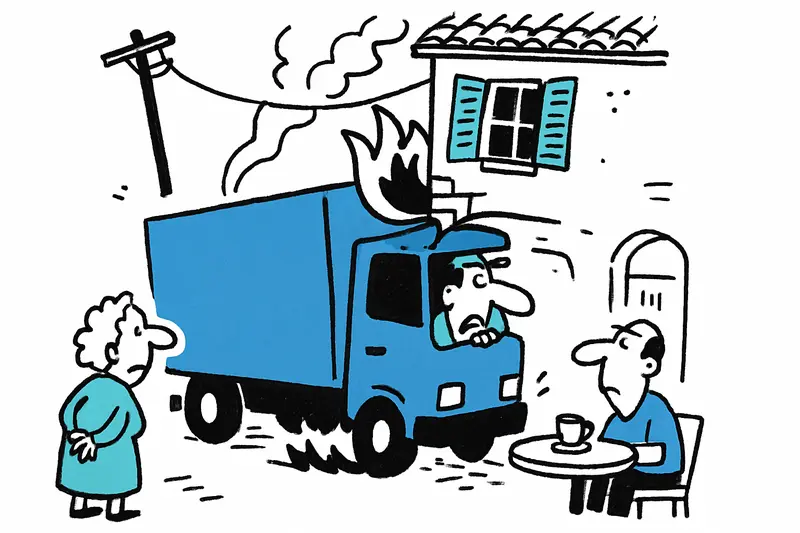
On Friday morning a narrow lane in Esporles briefly turned into an incident scene: a truck collided with the lower part of a bay window, became lodged there, pulled a high-voltage line to the ground and the cargo area caught fire. The local police and the fire brigade were quickly on site. With extinguishers a larger spread of flames was prevented, the power supply was temporarily shut off and emergency crews let air out of the tires to remove the vehicle without further damaging buildings.
The scene: shutters clatter, an elderly woman watches from the plaza, espresso cups keep rolling in a corner café, the smell of diesel mixes with the faint scent of burning from the cargo area. We know these images on the island — narrow streets, historic houses close to the roadway, and then a vehicle that doesn't really fit the scene, as in How does a truck end up on the cloister steps? Sóller mishap reveals a systemic gap.
Critical analysis: At first glance it looked like a driving error or wrong routing. On closer inspection the incident reveals several weaknesses: the proximity of high-voltage lines to historic facades, a lack of physical barriers or warning systems for overheight vehicles in sensitive village centers, and traffic management that apparently did not prevent such a tall vehicle from choosing this street in the first place. Added to that: when cables hang this low, a single mishap is enough to leave several houses without power.
What is often missing in public discussion: there is a lot of talk about speed and alcohol at the wheel, but hardly anything about traffic routing for heavy and tall vehicles in villages with narrow streets. Equally little attention is paid to how many critical spots there actually are — from place to place these are often individual weak points that are rarely mapped and certainly not prioritized for repair. And almost never is the responsibility of dispatchers at large transport companies discussed, who choose routes via GPS instead of locally adapted instructions, a problem seen when a stranded truck on the Ma-20 threw Palma off balance in Ma-20 Blocked: A Truck Breakdown and the Vulnerability of Palma's Roads.
Everyday scene from Esporles: a delivery driver who goes to the bakery on Carrer de la Vila every morning nods matter-of-factly: "You have to drive in slowly here, otherwise nothing fits." That day, however, the whole neighborhood watched as the tires were let down, the firefighters clambered over the steps like in an old utility vehicle and neighbors with blankets gently pushed the onlookers aside. Fortunately there were no injuries.
Concrete solutions that could have an immediate effect: clear height restrictions at street entrances with highly visible signs and physical barriers; fixed truck routes recorded in logistics apps and by shipping companies; local inspections using spot height measurements; and training for drivers who regularly deliver into historic village centers. More technically demanding but sensible long-term measures would be to deliberately bury cables at particularly sensitive points and for network operators to create a prioritization plan for such bottlenecks — concerns echoed in coverage of infrastructure failures after weather events such as Stormy night in the island's interior: What's missing when rain becomes a problem?.
What also helps: a simple map of critical points in each village, accessible to fire brigade, police, utility companies and local businesses. It costs little and saves time in an emergency. Cooperation is the keyword here: if the municipality, the utility and the transport companies share their information, unplanned blockages become less common.
Punchy conclusion: the case in Esporles was a warning signal with a fortunate outcome. No injuries, rapid intervention — but also a clear sign: our villages are charmingly convoluted, but vulnerable. Those who want to prevent the next mishap must routinely plan routes, assess cables and act at bottlenecks before a street becomes an incident site again, as other serious collisions have shown in pieces like Crash on the Ma-10: Bus collides head-on with a truck — What does this say about our roads?.
Frequently asked questions
Why are narrow village streets in Mallorca so vulnerable to trucks and delivery vehicles?
Can a truck collision in a Mallorca village cause a power cut?
What should drivers check before bringing a large truck into a Mallorca village center?
Is Esporles difficult for delivery trucks and other large vehicles?
What safety measures can prevent truck accidents in Mallorca villages?
What happens when a truck catches fire in a Mallorca street?
Why are overhead power lines a problem in older Mallorca villages?
What does the Esporles truck incident say about Mallorca’s village infrastructure?
Similar News
Car on MA-13 near Inca in flames – a safety check for the island
A vehicle caught fire on the MA-13 towards Alcúdia on Tuesday afternoon. The driver was uninjured, the car was destroyed...

Real Estate in Mallorca: Fewer Buyers, Higher Prices — What's Behind It?
Sales on Mallorca are falling, yet prices continue to climb. Why fewer transactions do not equal relief — and what shoul...
Just Bought — Already Trouble: Water Damage in the Heiters' Villa and What Owners in Mallorca Should Know Now
A newly purchased sea-view property — and within days a water damage. What risks lurk in new properties in Mallorca, and...

Rich, Richer, Mallorca? A critical look at the growing super-rich bubble
Numbers: Around 3,600 millionaires in the Balearic Islands hold a combined €27.6 billion. What this concentration of wea...
Chain reaction on the MA-1: Eight injured in rear-end collision near Portopí
On Tuesday morning there was a crash at the Andratx exit to the MA-1 towards Palma: a rear-end collision between a car a...
More to explore
Discover more interesting content

Can Cap de Bou

Townhouse Lleo 72
