
Voracious Termites in Artà: When Does Wood Become a Trap?
Voracious Termites in Artà: When Does Wood Become a Trap?
New termite findings in Artà are alarming homeowners: wooden ceilings were damaged and a room ceiling partially collapsed. The municipality urges inspections and reports suspected cases.
Voracious Termites in Artà: When Does Wood Become a Trap?
Key question: How well are our homes protected when tiny insects hollow out load-bearing timbers?
The municipality of Artà recently warned of termite infestations in several buildings. Affected sites include houses on Carrer de les Roques and Carrer de Josep Sanxo de la Jordana as well as the municipal building in Colònia de Sant Pere. About nine months ago, a residential building on Carrer de les Roques experienced a partial collapse of a room ceiling, as reported in After a Roof Collapse in Artà: Termite Alarm on Carrer de les Roques — Who Takes Responsibility Now – a clear sign that the damage is not merely cosmetic.
The administration's recommendation is clear and simple: look, inspect, and, if necessary, hire experts. This includes removing door casings, checking wood structures that are hard to see, and engaging certified firms for construction, architecture, or pest control. Also: detected cases should be reported to the municipal administration so the spread can be better monitored.
Critical analysis: Many homeowners first associate termites with tropical stories and overlook that the insects are also active here in protected, poorly ventilated wooden areas. Mallorca's mild climate and damp corners in older buildings provide ideal conditions. The problem is not only local: once load-bearing beams or ceilings are affected, the safety risk increases significantly – as the partial collapse shows; similar incidents elsewhere in Mallorca are documented, for example Hole in the Roof of Valldemossa Charterhouse: Wake-up Call for a Historic Quarter and Alarm in Son Bauló: When an escar loses its roof. Experts also warn against merely painting over or patching up damage with quick fixes; the danger of a later, costlier failure remains.
What is often missing in public debate is a pragmatic discussion about liability, insurance, and support for owners with limited means. It's not enough to just spread warnings. Many people do not know whether their buildings are insured against damage to wooden beams, who will pay for a renovation, or what reporting deadlines and obligations apply. The systematic recording of affected buildings is also little considered: without a map of infestations, prevention remains piecemeal. This lack of clarity has been highlighted in local coverage, for instance Termites under the Roof: Why a House in Artà Becomes a Warning.
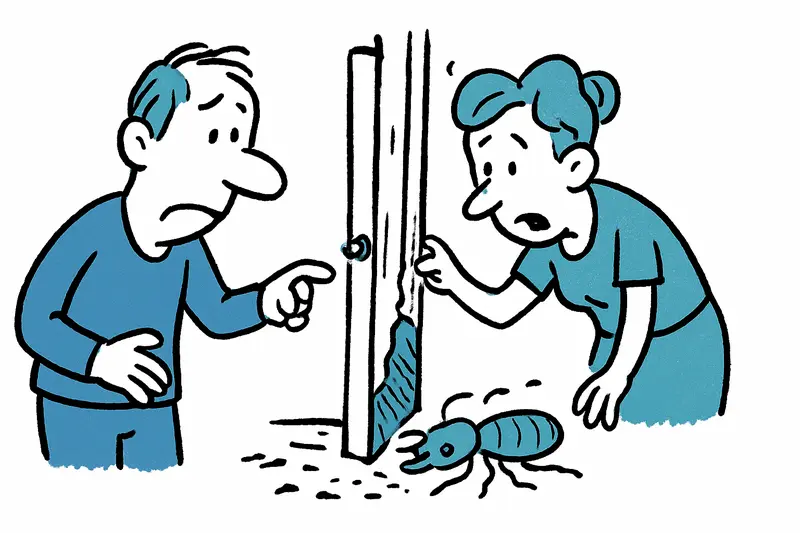
Everyday scene from Mallorca: walking along the warm Carrer de les Roques, cicadas chirp in the plane trees, and a fine layer of wood dust like flour lies on the doorstep. A neighbor lifts a corner of a door casing with concern; behind it brittle wood appears. Such small observations are often the first clue. Many here know someone with an old house where gentle renovations used to suffice – today hidden galleries of insect damage can suddenly play a structural role.
Concrete, immediately implementable solutions:
1. Visual inspection and documentation: Owners should systematically check door and window frames, ceiling edges and roof beams. Take photos with dates and mark small damages.
2. Professional inspection: As soon as there is suspicion, call in professional pest controllers or structural engineers/architects. The municipality recommends this anyway; it is important to choose certified companies.
3. Technical measures: Improve ventilation in cavities, use wood preservatives according to professional guidance, and install chemical or physical barriers where appropriate.
4. Repair and reinforcement: Affected beams must be replaced or structurally reinforced if necessary. This is not a cosmetic repair but a matter of safety.
5. Reporting and information duties: Report detected infestations to the municipality. A central registry allows for more targeted prevention and warning conversations with neighbors.
6. Preventive neighborhood actions: Especially in historic districts, organize joint inspections so that an infestation does not silently move from house to house.
Who bears the costs? Transparency is needed: owners should check their policies and, if in doubt, ask insurers whether damage from wood pests is covered. Municipal advisory services or collective contracts with certified firms could help reduce costs for individuals.
What the municipality could additionally do: provide a simple, publicly accessible checklist for detecting termites, hold regular information evenings in affected areas, and create an anonymized map of reported cases to give affected residents orientation. Targeted subsidies for urgently needed securing measures on listed or older houses would also be useful.
Concise conclusion: Termites are small, but their impact can be large and dangerous. Those living in older buildings or with wooden ceilings should not wait. In Mallorca the conditions exist for a hidden problem to grow quickly. Check wooden elements, make notes, call in experts and report suspected cases – that's the short action plan. Better to lift a door casing and find nothing than to have a ceiling suddenly give way.
For support: first contact local construction or pest control firms, check insurance policies and report findings to the municipality. That way Artà will not remain an isolated case but become an occasion for targeted neighborhood prevention.
Frequently asked questions
Are termites a common problem in Mallorca and how should residents respond?
What are the early signs of termite damage in older wooden Mallorca homes?
What steps should a homeowner in Artà take if they suspect termites?
Who covers the cost of termite repairs in Mallorca and how can homeowners prepare?
What happened on Carrer de les Roques in Artà regarding termites?
Why is the Colònia de Sant Pere municipal building mentioned in termite warnings?
How can communities in historic Mallorca districts prevent termite spread?
What should I do if I discover termite damage and want to help track infestations in Mallorca?
Similar News

Mistaken identity with fatal consequences: Brutal assault in S'Aranjassa — what's missing in the follow-up?
At S'Aranjassa a visitor to a finca was tied up, beaten and thrown out of a van. Three men have been arrested, including...

High heel slips, car accelerates: accident on Camí de Son Hugo
A woman lost a high-heeled shoe on the forecourt of the sports facility at Camí de Son Hugo. The car accelerated, mounte...

Phone Scam: How Two Hotel Employees at Playa de Palma Lost Thousands of Euros
One morning in September, two reception employees at Playa de Palma were pressured by alleged alarm-company staff — in t...
When the Wallet Becomes a Danger: Attack in Peguera and Lessons for Mallorca
In Peguera, two women are said to have stolen the wallet from a 75-year-old German couple. When the victim intervened, t...
Plata stays Plata: Young people take over, Llonguets remain
A small bar on Carrer de l'Argenteria will continue: Tolo Serra hands the place over to young Mallorcans at the end of t...
More to explore
Discover more interesting content

Can Cap de Bou

Townhouse Lleo 72
