
Who Forgot the Dead in the Sands of Sa Coma?
Ninety years after the outbreak of the Civil War in Spain: dozens of men reportedly ended up in anonymous graves on the beach of Sa Coma. Why do many questions remain unresolved?
Who Forgot the Dead in the Sands of Sa Coma?
A guiding question for the 90th anniversary of the outbreak of the Civil War
Who bears responsibility for the fact that questions still remain on the beach of Sa Coma, where bodies were buried, bones moved or memories buried? This is the central question that this July drifts through the narrow streets of Sant Llorenç and fades away at the counters of cafes in Manacor.
Brief situation: In the weeks after the coup of 18 July 1936, republican forces landed on the east coast near Porto Cristo and Sa Coma in August. In September 1936 there were reported mass shootings on the coast; about 80 were said to have been killed; in recent years archaeologists and forensic specialists have searched for the missing at several sites on the island. Recent recoveries include a body recovered off the east coast near Portocolom. In total, several hundred skeletons have been recovered so far; in dozens of cases relatives have been able to receive their dead.
Critical analysis: Memory is not a law of nature; it is made — and contested. On Mallorca the process of reckoning has gone in two directions: on the one hand the scientific search for traces with archaeology and genetics, on the other hand the political dispute over a memory law, which has suffered setbacks in recent years. When laws are at stake and courts decide who may dig and who may not, it is no longer just about bones, but about political authority over interpretation. Financial resources, access to archives, the arming of archives with digital copies — these are the inconspicuous levers on which remembrance succeeds or fails.
What is missing in public discourse: the voices of grandchildren. Debates are dominated by legal battles and historical megaphones; those affected often remain peripheral figures. Also underexposed is the question of how many sites were actually systematically documented and secured — and which traces may have been irretrievably lost because construction, paving or concreting took place in recent decades. Coastal discoveries such as the third corpse found at Es Trenc within a week underline how remains continue to surface.
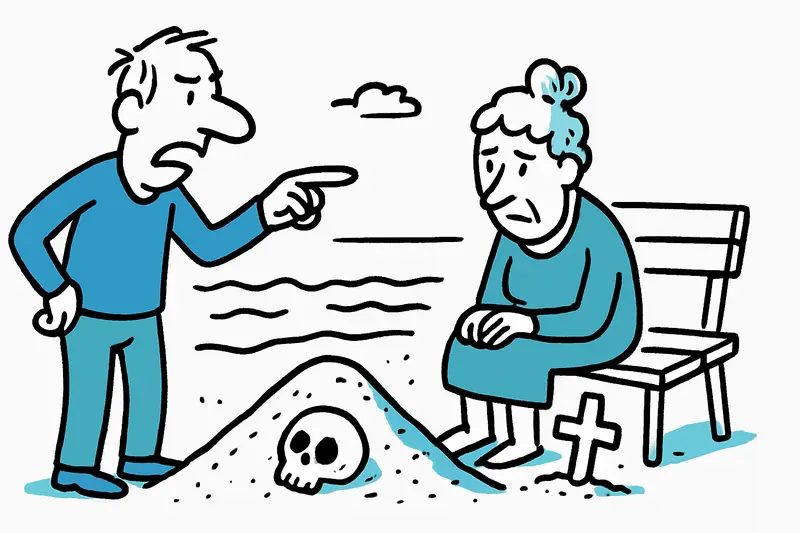
An everyday scene: On a hot July day now, with the roar of motorcycles on the Ma-15 and the smell of fried fish in Palma, walkers pass the promenade of Sa Coma. Children build castles from wet sand, tourists pose for photos at Punta de n'Amer. No one sees the scars below the surface. Recent incidents, like the two dead on Balearic coasts, show how the sea still withholds and returns unanswered remains. An elderly woman on a bench, who grew up here, whispers that her aunt once went missing. Such voices are the true witnesses — not the headlines.
Concrete approaches:
1) Transparent database: A publicly accessible inventory list of all excavations, finds and DNA results (anonymized, family-protected), managed by an independent island commission.
2) Local DNA contact points: Mobile teams that inform relatives in communities, take samples and help with bureaucratic matters. Costs to be covered by regional and state authorities with clear prioritization.
3) Protection of sites: Building freezes at suspected sites, mandatory archaeological pre-investigations before coastal construction and a reporting office for suspected areas.
4) Education and commemorative work: Curricula that incorporate regional memory, as well as decentralized sites of remembrance: plaques at beach access points, small audio stations with eyewitness texts and maps explaining the course of events — factual, local and without heroic rhetoric.
5) Depoliticized support: Exhumations and identifications must not become hostages to political power games. A non-partisan expert commission can provide protection here.
Punchy conclusion: It's not just about bones in the sand. It's about the question of how a society deals with its violent chapters — whether it conceals, instrumentalizes or seriously strives to name the missing and reconcile families. If Mallorca today lives between sunbeds and promenade cafes, then the task falls to all of us: not only to remember, but to create the conditions under which memory can become reliable. Otherwise haystacks and rumors will remain the only memorials.
Recent reports of recovered bodies, such as investigations in Ciutadella and off Alcúdia, keep the issue in public view and underline the continuing relevance of these proposals.
Frequently asked questions
How is the memory of the Sa Coma killings being addressed on Mallorca today?
What steps are proposed to make Mallorca's archaeological records transparent?
Who should lead exhumations and identifications on Mallorca to avoid political influence?
Why are grandchildren's voices important in Mallorca's memory debates?
What kinds of protections are proposed for Mallorca's memory sites and coastal archaeology?
What forms of education and remembrance are suggested for Mallorca's memory sites?
Who should pay for identification, dignified burials, and memorials in Mallorca?
What is the broader purpose of addressing past violence on Mallorca beyond recovering bones?
Similar News
Mistaken identity with fatal consequences: Brutal assault in S'Aranjassa — what's missing in the follow-up?
At S'Aranjassa a visitor to a finca was tied up, beaten and thrown out of a van. Three men have been arrested, including...
High heel slips, car accelerates: accident on Camí de Son Hugo
A woman lost a high-heeled shoe on the forecourt of the sports facility at Camí de Son Hugo. The car accelerated, mounte...

Phone Scam: How Two Hotel Employees at Playa de Palma Lost Thousands of Euros
One morning in September, two reception employees at Playa de Palma were pressured by alleged alarm-company staff — in t...
When the Wallet Becomes a Danger: Attack in Peguera and Lessons for Mallorca
In Peguera, two women are said to have stolen the wallet from a 75-year-old German couple. When the victim intervened, t...
Plata stays Plata: Young people take over, Llonguets remain
A small bar on Carrer de l'Argenteria will continue: Tolo Serra hands the place over to young Mallorcans at the end of t...
More to explore
Discover more interesting content

Can Cap de Bou

Townhouse Lleo 72
