
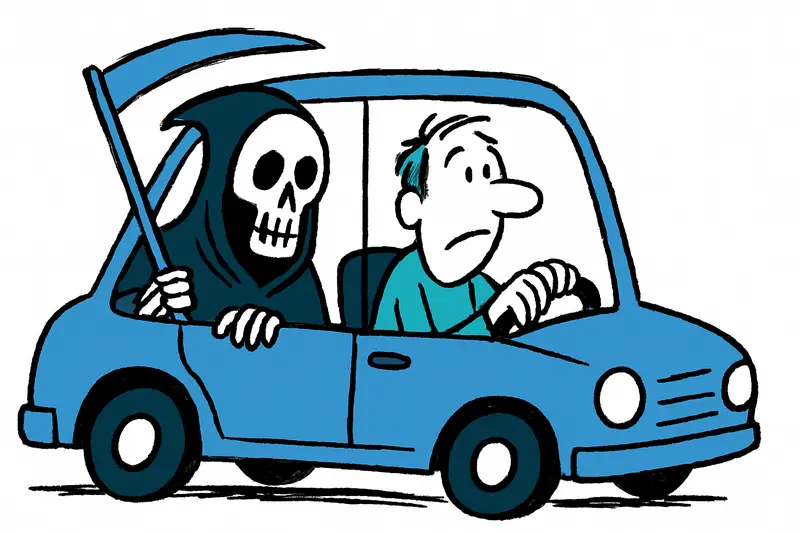
Death rides along – when speed becomes an everyday concern
Death rides along – when speed becomes an everyday concern
A well-known motorsport competitor dies during a rally in Mallorca. Why do we accept residual risk on our roads in everyday life — and what would have to change so that more people return home alive?
Death rides along – when speed becomes an everyday concern
A guiding question, everyday life, some hard facts
Guiding question: Who takes responsibility when a hobby, an event or a trip from the shopping center ends in death?
The death of an experienced rally driver at a weekend event hits personally and collectively. Personally for the family, because at a seat at the table someone is suddenly missing. Collectively, because such accidents raise the question of how we deal with roads, speed and risk — not only in motorsport but also in everyday life. The numbers are stark: In 2025, 2,832 people died on German roads; on Spanish interurban roads there were 1,119 victims, on the Balearic Islands 31; at the EU level it was around 19,400 deaths. These magnitudes are not abstract statistics; they stand for neighbour families, bus drivers, bike couriers and tourists. Local reporting, for example Too Many Deaths on Motorcycles: How Mallorca Can Stop the Summer Trend, highlights the human side.
It is not helpful to judge the deceased or issue black-and-white verdicts about motorsport. Experience does not protect against the laws of physics. A sports car with hundreds of horsepower needs space, ideal conditions and infrastructure that safely allows such speeds. What is regulated on racetracks with marshals, schedules and safety buffers is often missing when similar activity is moved onto public roads.
Where does the discourse falter? First, in transparency: events on public ways are quickly discussed in emotional tones, but the details — timing, road conditions, rescue access — remain unclear for a long time. Second, the perspective of risk prevention is often missing: instead of asking how accidents can be avoided, we quickly talk about blame and fate. Third, many do not speak about the strain on rescue infrastructure: how quickly can an emergency doctor reach a rugged mountain road in the Serra de Tramuntana? Who bears the costs for recovery operations, closures and follow-up measures? Recent incidents such as Fatal accident on the Ma-19 near Llucmajor: Why motorcyclists are repeatedly affected have focused attention on those challenges.
A piece of everyday life in Mallorca: in the morning, with asphalt still damp from night rain, cyclists push their bikes up the narrow stretch near Sóller. Delivery vans pull over, a moped struggles next to a steep stone wall; an elderly woman waves from a white Fiat because a school bus is stopping. This narrowness is typical for many island roads: no runoff zones, tight curves, walls, vegetation, often poor surface after heavy rain. When a rally‑prepared sports car appears there, the margins are small.
So what is concretely missing in the public debate? A sober discussion about events on public roads. Clearer rules about who may use such routes. Mandatory technical inspections before every event. Ambulance plans that are not improvised. And better data collection: where do which accidents happen, under what conditions, with which vehicle types?
Concrete proposals that would be practicable: temporary road closures only with certified marshals and clearly defined evacuation routes; mandatory accompaniment by emergency teams with rescue and recovery helicopter standby for particularly vulnerable sections; a duty to document accident analyses so that safety standards grow from every incident; promotion of advanced driver training for those who drive high-performance cars privately; improved signage and surface maintenance on winding passages, especially after storms. These ideas echo recommendations in Why Mallorca Remains Dangerous for Bikers — and What Could Really Help.
It is also time for open communication between authorities, organisers and residents. Whoever approves a rally should make public how risks were assessed and how the rescue chain would work in an emergency. Residents must have a say because it is their everyday life that is affected — their quality of life must not be sacrificed for events.
Conclusion: speed is a fleeting feeling; the consequences remain for a long time. We cannot eliminate every risk from every trip, but we can create conditions that reduce residual risk. That does not mean bans as a reflex, but rules, controls and respect for the road. If we truly mean that life matters more than adrenaline, the debate starts now — on our roads, in our villages and on every mountain pass of the island.
Frequently asked questions
When is Mallorca at its best for sightseeing and outdoor activities?
Is it safe to swim at Mallorca's beaches?
What should I pack for a Mallorca trip?
What are the essential places to visit in Mallorca?
What outdoor activities are popular in Mallorca?
How easy is it to travel between towns on Mallorca?
When is the beach season in Mallorca and what should I know about water conditions?
What local foods should I try while in Mallorca?
Similar News
Unrest in Es Pillari: Neighbors Push Back Against Fear of Squatting
In Es Pillari, a small village near Palma, concerns are growing after reports of attempted intruders. Why the fear is so...
There is room for everyone — and yet not for everything: Parc de Ses Estacions, 20 years on
The Parc de Ses Estacions marks two decades above Palma's underground station. A walk reveals green spaces, everyday lif...
People and the Island: Why We Know So Much and Change So Little
A critical inquiry from the Llucmajor hinterland: we know the problems — plastic, illegal dumping, animal suffering. Why...
Fear of Squatting in Es Pil·larí: Why the Mood Is Shifting
In Es Pil·larí, a district of Palma, a wave of warnings is circulating in neighborhood groups. Residents report attempte...
Partial collapse at Palma airport – who is liable for dilapidated infrastructure?
Heavy rain caused part of a plasterboard ceiling and the roof of a former cinema to partially collapse in Son Sant Joan....
More to explore
Discover more interesting content

Can Cap de Bou

Townhouse Lleo 72
