
Garbage, Stench, Fire Risk: What Is Really Going Wrong in Son Bauló
Garbage, Stench, Fire Risk: What Is Really Going Wrong in Son Bauló
An apartment ensemble illegally built for years near Son Bauló is falling into disrepair, largely occupied and creating health and safety risks. A critical assessment with concrete solution proposals from a Mallorca perspective.
Garbage, Stench, Fire Risk: What Is Really Going Wrong in Son Bauló
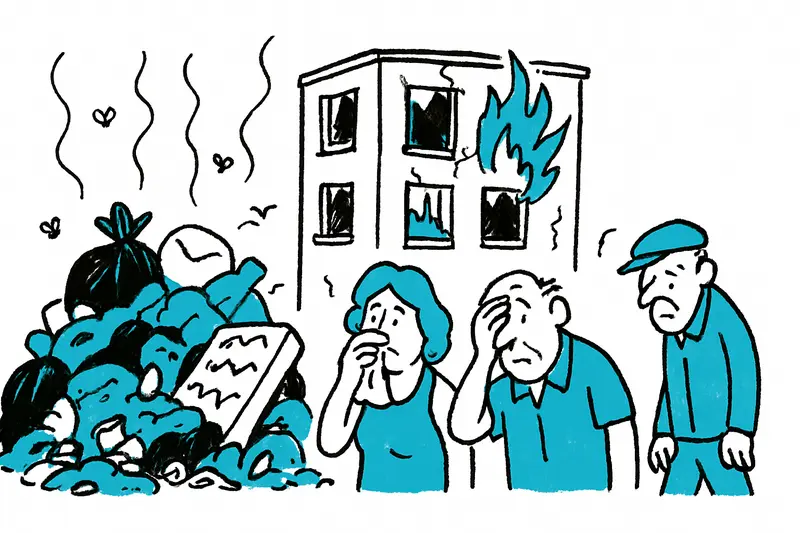
On a hot August morning a smell rises from the decaying Espigol Beach complex in Son Bauló that fogs the shutters of neighboring houses. Moped engines rattle, seagulls cry over the sea, and residents on the edge of the village hold their breath as they pass by. From simple observations a larger problem quickly becomes clear: an illegally constructed housing ensemble is falling into disrepair, is largely occupied, and brings hygiene and safety risks to the immediate neighborhood.
Clear guiding question
How can the municipality find a practical solution that balances protecting the neighborhood, enforcing building law, and treating the residents humanely?
Critical analysis
The facts are unmistakable: the complex consists of two blocks, one of which was badly damaged last summer, as reported in Alarm in Son Bauló: When an escar loses its roof, and has continued to decay since. Standing water in one of the pools has promoted a mosquito infestation. A rubbish heap has formed between the blocks. Residents report that wastewater is being discharged openly onto the street. The inhabitants have organized their own water supply with improvised pipes and use makeshift solar panels on the roofs that could fall at any time due to wind and age. All of this increases the risk of fire and health hazards.
The situation is not only a legal problem (illegal construction, occupation) but also a failure in maintenance, hazard protection and public infrastructure. Authorities have been informed, but the orders and measures have not yet taken effect — or they are not sufficiently visible to the people who pass the complex every day and have to endure the smells.
What is missing in the public discourse
In public debate the catchword "squatting" is often mentioned, as discussed in Who Acts First? Squatters in Santa Margalida Cause Trouble in Half-Finished Housing Blocks. Rarely are the practical consequences for the environment, the neighborhood and health discussed. Also lacking is the question of which social services exist: Are there clearer pathways for people in precarious situations to gain access to accommodation, drinking water and a responsible power supply without endangering others? And: who covers the costs of demolishing illegal buildings when owners cannot be located?
Everyday scene from Mallorca
In the early evening residents sit on folding chairs in the street that leads to the coast and wipe the sweat from their brows. An old fisherman shakes his head as he walks past the overgrown paths; the local children avoid the puddles where mosquitoes breed. The pile of rubbish at the entrance consists of old mattresses, plastic bags and food leftovers — a place that resembles a sidetrack more than liveable housing.
Concrete solutions
1) Immediate measures to avert danger: secure or remove hazardous solar panels, temporarily seal open wastewater pipes, drain standing water in pools and organize rapid pest control. 2) Create clear responsibilities: the municipality must review the legal situation and reconstruct ownership; at the same time health and building inspection authorities should intervene jointly. 3) Offer social alternatives: instead of pure eviction there must be a plan for the residents — emergency shelters, referral to social services, clearly regulated transitional solutions. 4) Waste disposal and hygiene management: regular collection, designated container sites and cleanup campaigns with local participation. 5) Long term: enforcement of building law tied to a restoration fund — if owners do not pay, the municipality should intervene financially and later seek reimbursement.
Why these approaches are realistic
The proposed steps combine technical immediate aid with administrative pressure and social responsibility. In Mallorca there are capacities for emergency shelters and pest control; the problem is usually coordination and prioritization, not a lack of resources. A coordinated action would reduce the immediate danger and at the same time strengthen the legal framework.
Pithy conclusion
The situation in Son Bauló is not an isolated nuisance but a symptom: when building ruins, occupied apartments and improvised supply routes come together, a mixture of risk and resignation emerges — for residents and neighbors alike. A solution must be both practical and humane: remove dangers in the short term, absorb people in the medium term and restore the rule of law in the long term. Only in this way can the neighborhood be protected from stench and fires and people be spared from being uprooted.
Frequently asked questions
What safety and health issues are linked to the illegal housing complex near Son Bauló in Mallorca?
How should a Mallorca municipality balance neighborhood protection, building-law enforcement, and humane treatment for residents in cases like Son Bauló?
What immediate actions can reduce danger in urgent housing situations like Son Bauló on Mallorca?
What social support options should be considered for residents living in illegal housing in Mallorca?
How can waste disposal and hygiene be improved in neglected housing blocks in Mallorca?
What long-term strategies exist for enforcing building laws and funding restoration in Mallorca communities?
Why is coordination among public services crucial in Mallorca when dealing with illegal construction and health hazards?
How does public discourse around squatting in Mallorca address practical consequences, and what questions should be asked?
Similar News
Why Mallorca Has Become So Terribly Expensive — A Reality Check
Rents are exploding, staple food prices are rising, wages are lagging behind. A look at the causes, what is missing from...
When Paradise Becomes Unaffordable
Hotel rooms, paella and the weekly grocery shop: Mallorca is becoming more expensive for many. Who pays the bill — guest...
End at Ballermann: What Is Lost with the Dino Mini Golf at Playa de Palma
On October 25 the dinosaur mini-golf course at Playa de Palma will close after more than 30 years. Why the city is recla...

Expensive Address Calvià: What Does First Place Mean for Mallorca?
The National Institute of Statistics (INE) ranks Calvià as Spain’s most expensive municipality for property purchases. W...

Emergency over Spain: Ryanair Dublin–Tenerife flight diverted to Santiago after medical emergency
A Ryanair flight from Dublin to Tenerife was diverted to Santiago de Compostela due to a passenger's acute health proble...
More to explore
Discover more interesting content

Can Cap de Bou

Townhouse Lleo 72
