
Heat in the terminal: Who protects the security staff at Son Sant Joan Airport?
Heat in the terminal: Who protects the security staff at Son Sant Joan Airport?
Around 100 security employees per shift are working without air conditioning in Palma, according to FTSP‑USO. The union has filed a complaint against Aena with the authorities. A reality check: what is missing, who is responsible — and how can the situation be resolved in the short and long term?
Heat in the terminal: Who protects the security staff at Son Sant Joan Airport?
A reality check on the complaint against Aena
Main question: Who steps in when the air conditioning fails in the departure hall and temperatures push workers to the limits of what they can bear?
The hard facts are sparse: the union FTSP‑USO reports that around 100 security officers per shift at Palma (Son Sant Joan) airport, as described in Palma: Why the security checks become a test of patience, are currently working without functioning air conditioning. It has therefore filed complaints with the labor inspectorate and the Balearic Institute for Occupational Safety and Health (IBASSAL). Aena points to technical faults; Trablisa provides the security service but is not responsible for building systems.
Critical analysis: On paper responsibility is clear — Aena, as operator, owns and manages the buildings — in practice the problem is more complex. Maintenance cycles, spare part procurement, budget lines for repairs and the contractual allocation of duties between operator and contractor often lead to delays, as shown by Water chaos in Terminal C: Who protects the pipes — and passengers?. When an air conditioning system fails during the summer months, it's not just uncomfortable: the combination of heat, physical work and dense passenger flows increases the risk of circulatory problems, loss of concentration and mistakes in safety-critical checks.
What is missing from public debate so far: transparency. There is little insight into maintenance schedules, how quickly repairs are commissioned and which budget decisions lie behind recurring failures. Equally rarely discussed is how contract clauses between Aena and service providers like Trablisa provide — or fail to provide — fallback and protection mechanisms for employees. The passengers’ perspective is often reduced to comfort, instead of discussing the safety consequences of poor working conditions, a debate that has surfaced in Palma before the departure chaos: Ground staff strike plans put the island to the test.
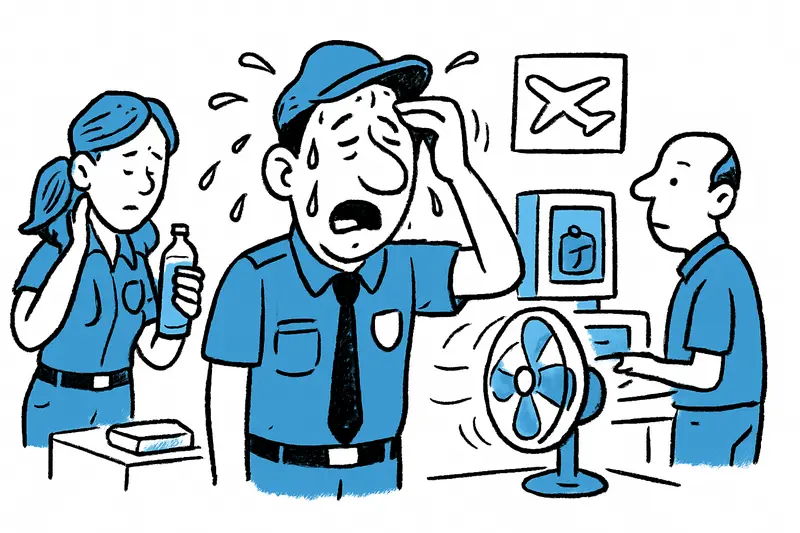
Everyday scene from Mallorca: Around 2 p.m., when the afternoon heat bears down on the finishes of the departure hall, you see staff at the control counters juggling paper invoices, bottles of water and fans, a situation mirrored in Tupperware Instead of Plates: Why Lunch Breaks at Palma Airport Became a Test of Patience. A colleague tucks a damp cloth into her neck, a young coworker goes to the cafeteria to get ice cubes. Outside a bus to Palma honks, inside a luggage scanner beeps — and still the question remains: who steps in when someone collapses?
Concrete short-term measures that could help immediately: mobile air conditioners and dehumidifiers for critical areas; mandatory shortened shifts and extra breaks during heat alerts; clearly visible drinking stations and first-aid posts; mandatory heat checklists signed jointly by Trablisa and Aena. Authorities like IBASSAL can issue temporary orders — for example maximum working temperatures in defined areas — until systems are repaired.
Long-term measures: a publicly accessible maintenance and investment plan for the entire air-conditioning infrastructure; clear sanctions in operator and contractor contracts that do not treat outages as mere “technical faults”; independent audits of building systems before each summer season; training for employees to deal with heat stress and binding emergency plans for peak periods.
Why this matters: airport security is a system. If people who check and protect passengers suffer from heat stress, attention falls, error rates and medical incidents rise — this affects not only staff but all travelers. In addition, it is a matter of fairness: workers should not have to pay the price for deferred maintenance.
Conclusion: the path runs on two levers at once: short-term crisis management and transparent, binding infrastructure planning. Aena must prioritize technical faults quickly and visibly, Trablisa should proactively demand the safety of its employees, and IBASSAL must not only register but act. For Palma this means: anyone who wants the airport to be the island’s calling card must also ensure that those who work there every day are not forced to toil in a hotbox of their workplace.
Frequently asked questions
What is the best time of year to visit Mallorca for good weather and swimming?
What should I pack for a Mallorca trip to stay comfortable and prepared?
Are Mallorca’s beaches suitable for swimming for beginners?
How easy is it to get around Mallorca without a car?
What foods should I try in Mallorca?
Should I stay in Palma or a coastal town for a Mallorca trip?
Which seasons are best for outdoor activities like hiking or cycling in Mallorca?
What safety tips should I keep in mind while visiting Mallorca?
Similar News
Finally Home: Mike and Leyla Heiter Buy Villa with Sea View in Mallorca
The reality TV couple Mike and Leyla Heiter have bought a house in Mallorca with a roof terrace and sea view. An Instagr...
Arrest after series in Palma: Who protects apartments from repeat offenders?
The National Police arrested a man in Palma who investigators say may have broken into several apartments. In one incide...
How a Teenager Without a Driver's License Stole a Rental Car — and What It Means for El Arenal
In El Arenal a minor took advantage of an unattended rental car with its engine running. Flight, climbing over walls and...
Three-ton llaut salvaged in Puerto Portals – volunteers clear microplastics from the harbor
During the weekend operation in Puerto Portals, divers pulled an approximately three-ton llaut from the harbor. Associat...
Naked Pillar in Bunyola: Why a Climbing Prank Is More Than an Accident
During the Sant‑Mateu verbena a 20‑year‑old fell at a protected wayside cross in Bunyola and pulled the stone cross off ...
More to explore
Discover more interesting content

Can Cap de Bou

Townhouse Lleo 72
