
Palma is getting denser, older and more expensive — How long can this last?
Palma is getting denser, older and more expensive — How long can this last?
The numbers are clear: neighborhoods around Playa de Palma are booming, the city is ageing, household incomes are rising — but housing is lacking. A reality check: which questions remain open, how does this feel in everyday life, and which solutions are realistic?
Palma is getting denser, older and more expensive — How long can this last?
Reality check: growth, housing and everyday life in a city under pressure
Key question: How can Palma cope with rapid population growth, rising population density and tight housing supply without destroying quality of life and neighborhood bonds?
The raw figures circulating from the city’s population office sound, at first glance, hardly poetic: neighborhoods like Les Meravelles near Playa de Palma have significantly increased their number of inhabitants within two decades — a phenomenon linked to rising prices even in outlying areas as explored in When Even the Periphery Breaks the 300,000‑Euro Mark – Palma and the Fight for Affordable Housing. Palma’s total population has passed the 480,000 mark and the city has noticeably become denser — almost 2,300 people per square kilometer. Added to this are a rise in average household income and an ageing population: the average age climbed from just over 37 years (2010) to almost 43 years (2024).
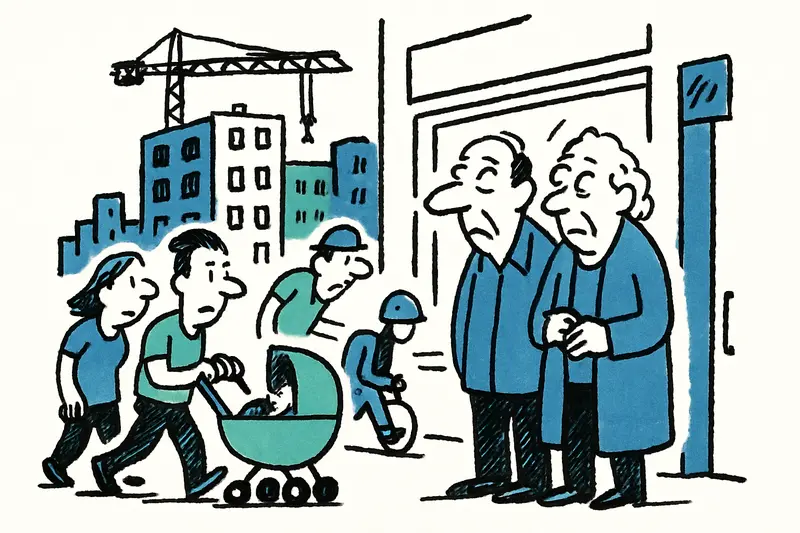
You can feel the result when strolling along Plaça de ses Meravelles on a cool January day: construction noise mixes with the trampling of delivery bikes, older couples in dark coats stand in front of small cafés, and young families with prams desperately search for affordable housing — the squeeze on affordable rooms is covered in When the Shared Flat Room Becomes a Luxury: Palma Under Pressure. The street smells of fried fish from a snack bar; a group of construction workers laugh at a radio programme while a moped buzzes along the waterfront. These scenes are not anecdotes, they reflect structural shifts; this is illustrated by reporting such as Palma: Cómo el lujo va ocupando lentamente los antiguos barrios obreros.
Critical analysis: the balance is lost. Population grows, land hardly does — since 2011 only minimally. Over ten years around 50,000 people were added, but only just under 7,000 new apartments, which drives density and prices. Rents rose particularly sharply in some periods, and the share of educated residents is high: one third of inhabitants were born abroad in 2024, and a good third hold a university degree. That creates demand for certain housing and services — and leaves less privileged households behind.
What is often missing from the public discourse: firstly, the everyday logic of population pressure — who works at night, who commutes into Palma during the day, which households are truly being displaced. Secondly, the spatial distribution of investments: many new builds are concentrated in a few locations instead of strengthening supply infrastructure across the city. Thirdly: missing clear figures on vacant dwellings and second homes in the municipal housing stock — a lever that would be politically effective but is hardly discussed publicly.
Concrete, realistic starting points, not wishful thinking:
1. Social housing with binding time frames: municipal or cooperative projects that do not fall onto the open market after a few years.
2. Fiscal incentives and sanctions: levies on vacant apartments, higher taxation of second homes combined with subsidies for long-term rentals.
3. Brownfield use and infill development at transport nodes: targeted additions at stops, not further consumption of greenfield land.
4. Strengthen tenants' rights: longer notice periods, more transparent rental contracts, rent index with binding effect.
5. Prioritise local supply and infrastructure: schools, health centers and bus connections must be built before new housing blocks attract residents.
An everyday scene as a warning sign: in a small shop near Passeig Marítim the owner recently complained that regular customers are moving away because the rent is rising. She herself had to lay off two employees. Such small stories add up to a societal problem: not only numerical, but in lost social ties.
Conclusion: Palma stands at a crossroads. Continuing as before — growth without clear steering — will deepen social division and make the city increasingly unlivable. Those who bear responsibility must not only point to figures, but adopt bold instruments: binding social housing, smart tax policy against vacancy, expansion of essential services and stronger participation at the neighborhood level. Short-term discomfort may be necessary; in the long run it preserves the city as we still smell and hear it on the Plaça in the morning. For a closer look at policy options and explanations for price dynamics, see Why Palma is expensive — and what could be done now.
Frequently asked questions
Why is Palma becoming more expensive to live in?
Is Palma getting too crowded for everyday life?
Why is Palma’s population ageing so quickly?
What is happening in Les Meravelles near Playa de Palma?
Why are rents in Palma rising so fast?
What housing solutions could help Palma in the long term?
How could vacant apartments help solve Palma’s housing shortage?
What does Palma’s growth mean for neighborhood life?
Similar News
Several Days of Rain Approaching: How Well Is Mallorca Prepared?
Aemet says: rain from Thursday until at least Tuesday, especially heavy on Monday. Temperatures remain mild. A reality c...

Nervous Reaction at a Traffic Stop: Why Campos Is Not Just a Sniffer-Dog Problem
At a traffic stop in Campos a 37-year-old German was arrested with a bag full of drugs. Our reality check explains why s...

Cameras Against Illegal Dumping: Porto Cristo Monitors Problem Areas – a Reality Check
Manacor has installed four surveillance cameras at particularly problematic waste spots in Porto Cristo. A local check a...
Reality check: Palma's "white" torrent — harmless salt or neglected warning sign?
White crusts on the Torrent de Sa Riera are causing a stir. Emaya describes them as salt deposits. Our reality check: wh...
When Ryanair's fleet grows: What Mallorca's travelers should know
Ryanair will soon receive 737 Max 10 jets. The larger aircraft offer potential savings — but also new risks for flight o...
More to explore
Discover more interesting content

Can Cap de Bou

Townhouse Lleo 72
