
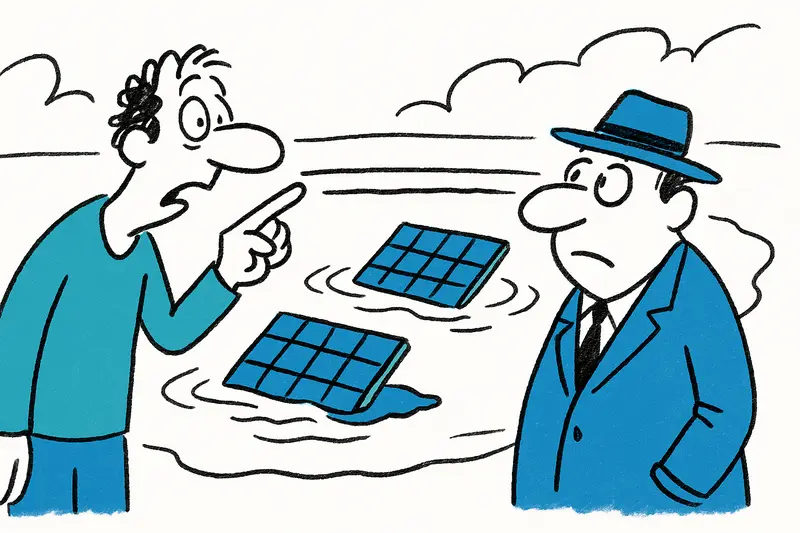
Panels sunk in the Inca reservoir: Was this an attack on the solar array?
Panels sunk in the Inca reservoir: Was this an attack on the solar array?
In an irrigation basin near Inca, floating solar modules sank after the blue floats caught fire. Police are investigating — how should Mallorca better protect its energy facilities?
Panels sunk in the Inca reservoir: Was this an attack on the solar array?
Guiding question: Was this targeted sabotage against renewable energy — or an accident that could have been easily prevented?
On the edge of the road from Inca to Sineu, opposite the county hospital, lies the irrigation basin that can hold up to 200,000 cubic meters of water and supplies the fields around Inca with treated water. In recent years about 9,497 square meters of photovoltaic modules floated there: individual 570-watt modules on blue floats, covering roughly a quarter of the basin's surface. Now many of these modules lie beneath the water surface because the buoyancy of the floats was lost when they caught fire.
The responsible security authorities have launched investigations; it is clear that the installation was disconnected at the time of the fire and therefore an electrical fault cannot be the cause. That raises the central question: Who or what set a fire on an unused, floating solar installation — and how could it happen unnoticed? The possibility of deliberate ignition echoes other recent incidents such as Nighttime Fires in S'Albufera: Six Ignition Points — How Do We Protect the Wetland?.
Technical observations: Plastic floats burn more easily than many assume. When they melt or tear, they lose their buoyancy; the modules attached to them sink. That is what happened here. The installation was financed under the NextGenerationEU reconstruction plan and is located in an irrigation basin that helps protect groundwater resources. A failure or damage to such installations affects not only investments but can also impair the functionality of the irrigation system and the normal operation of agriculture, with local precedents where residents faced prolonged water outages such as More than seven days without water: Inca families demand answers from Ibavi.
Public debate so far has revolved around assigning blame and the manhunt. What almost never happens is a systematic consideration of the vulnerability of such installations. Where were camera surveillance, fencing, lighting? Who monitors the site at night? How quickly can diving or recovery teams be on site? Who pays for the damage? Answers are needed, not only to catch perpetrators but to prevent similar cases in the future; recent investigations into suspicious fires and motives, including cases of arson linked to fraud, are relevant reading such as Attempted Insurance Fraud in Mallorca: Who Sets Fires — and Why the System Fails.
On the road on a hot morning it looks different: tractor trailers sway by, dogs bark, and espresso steam blows from a café; nobody expects an attack on photovoltaic modules while cleaning the olive trees. This everyday normality offers little protection: country lanes are easily accessible, irrigation basins are often remote, and installing solar modules on water surfaces creates visible but hard-to-guard infrastructure. Broader questions about national preparedness are also in play, as smoke from mainland wildfires has at times affected Mallorca, noted in coverage like Spain is Burning: Fire Traces as Far as Mallorca – Is the Country Really Prepared?.
Concrete actions that should be implemented immediately:
1) Visual screening and access control: Simple measures such as sturdy fences, gates with sensors and signs indicating alarms or ownership immediately improve protection.
2) Surveillance technology: Thermal and motion detectors combined with solar-powered cameras and alarm notifications to operators' smartphones are affordable today and can send an alert before a fire grows large.
3) Fire-resistant floats and modularity: For new builds, floating structures should be made of flame-retardant materials and designed so individual segments can be recovered without losing the entire surface.
4) Emergency and recovery planning: Municipalities, operators and protection authorities need joint plans: who dives, who pumps, who provides backup power, and how is irrigation management secured in the short term?
5) Preventive patrols and neighborhood alert networks: Regular checks by municipal or Guardia Civil patrols, supplemented by neighborhood reporting chains — farmers who work regularly at the basin are often the first witnesses.
6) Documentation and transparency: Open information on insurance coverage, repair times and possible impacts on water supply is important so residents and farmers can assess the consequences of such an incident.
What is missing in public discourse is an honest risk assessment: such projects are part of the energy transition, but they bring security questions that so far have been treated too much as a technical problem. There is a lack of accountability chains: who is liable if a NextGenerationEU-funded project fails — the authority, the operator, the insurers?
Everyday scene again: A farmer who takes water from the basin in the morning now looks at blackened edges on the shore and at damaged modules. He worries about water supply for his fields during the summer. That is a small, concrete consequence that does not always appear in investigation reports.
Conclusion: Whoever is behind the fire — the incident exposes a gap that cannot be closed by outrage alone. Short-term protection measures and long-term standards for floating solar installations are needed. Authorities should do two things now: conduct investigations quickly and transparently, and simultaneously present a security concept for similar projects in Mallorca. Otherwise the island remains vulnerable, precisely in the places where it wants to be especially innovative.
Frequently asked questions
What is the weather like in Mallorca in December?
Can you still swim in Mallorca in December?
What should I pack for Mallorca in winter?
Is December a good time to visit Mallorca?
What can you do in Mallorca in December?
What is Palma de Mallorca like in winter?
What is Sóller like in December?
What is the weather usually like in the Serra de Tramuntana in winter?
Similar News

Mueller continues expanding in Mallorca: Artà in 2026, Can Picafort in early summer 2027
The drugstore chain Mueller is opening two new stores in Mallorca: a 1,400 m² shop in Artà on 5 November 2026 and a bran...
The Painter Who Lived Mallorca: Franz Taussig and His Century-Old Secret
A hundred years ago a young Viennese arrived in El Terreno, sketched the island and called himself Francis Caron. Today ...

Airport dispute: Bridge, forecasts and the question of responsibility
A video by the Spanish transport minister has ignited the dispute over DORA figures, capacities and local governance pow...

The Painter Who Invented Himself: How a Young Viennese Drew Mallorca
A hundred years ago a 19-year-old draftsman arrived in El Terreno. His diary and sheets, long known under the pseudonym ...
Released with Conditions: The Plus Ultra Suspicion and a Mallorcan Finca as Residence
A Dutch entrepreneur, sought in connection with the Plus Ultra case, was extradited to Spain after his arrest in Germany...
More to explore
Discover more interesting content

Can Cap de Bou

Townhouse Lleo 72
