
Tragedy on the MA-4020: 23-year-old dies, police seek cause of crash
Tragedy on the MA-4020: 23-year-old dies, police seek cause of crash
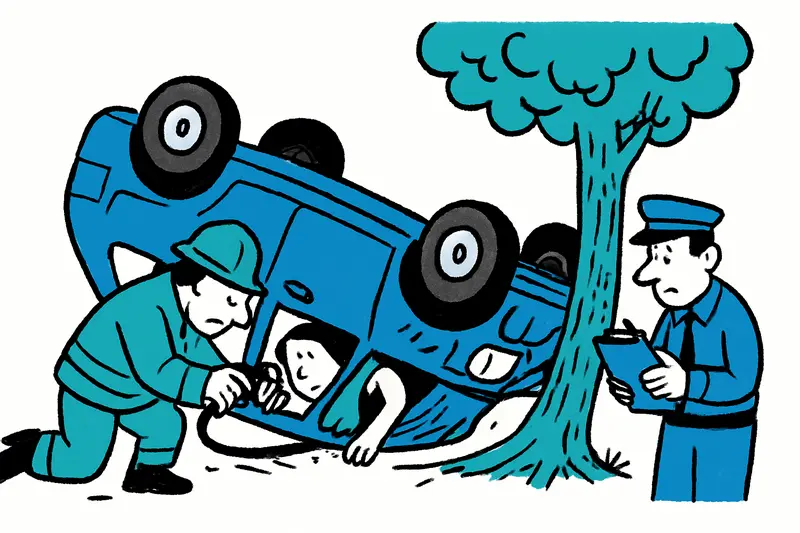
On the MA-4020 country road between Manacor and Porto Cristo a car overturned and hit a tree. A 23-year-old woman died and two men were injured. The traffic police are investigating.
Tragedy on the MA-4020: 23-year-old dies, police seek cause of crash
Car overturns between Manacor and Porto Cristo – firefighters had to free occupants
Around 11:50 p.m. on a late summer evening, a vehicle traveling toward Porto Cristo lost control and left the roadway on the MA-4020, about seven kilometers outside Manacor. The car overturned and struck a tree. The vehicle was so badly damaged in the collision that firefighters had to cut the trapped occupants out of the wreck.
A 23-year-old occupant could not be saved; rescuers only confirmed her death. A 41-year-old man sustained serious injuries and was taken to the Son Espases University Hospital in Palma. Another 35-year-old man suffered lighter injuries and was admitted to the Manacor hospital. Rescue services reported that the two men are from Uruguay.
The local traffic police have opened an investigation. It is currently unclear who was driving at the time of the accident and which factors triggered the crash. Initial indications point to driver inattention, but a definitive accident reconstruction is still pending.
Key question
How can a single driving error on a densely vegetated, poorly visible country road at night end so tragically?
Critical analysis
The exact cause of this accident remains unknown, but the scene on the MA-4020 brings together several problematic elements: late hour, a country road with limited lighting, possible high speed, and the presence of fixed obstacles such as roadside trees. On many island roads there is little margin for error; a vehicle leaving the lane quickly ends up on hard ground or collides with a tree where guardrails are sometimes missing. This pattern is mirrored in other incidents, such as the fatal head-on crash on the PM-401.
Added to this are rental car traffic and drivers unfamiliar with the island, or people who are tired at night. Control measures such as targeted speed enforcement at accident hotspots are partly missing or not in place when risk is highest: at night and on weekends.
What is missing from the public discourse
Reporting often focuses on the tragic event itself and less on systemic causes, as was the case after a head-on crash near Manacor that left two dead: Why are so many trees still directly next to the road? Where are reflective posts or guardrails missing? How well organized are night patrols by the traffic police, and how connected is the accident record to data on speed, lighting and vehicle age? Answers to these questions are lacking in the discussion, as are figures on recurring accident sites along the MA-4020, and similar questions followed the fatal accident on the MA-5013 near Sant Jordi.
Everyday scene from Mallorca
Anyone driving from Manacor to Porto Cristo in the evening knows the changing light conditions: spots where solitary streetlights create islands of light behind olive groves, and dark stretches in between where only the chirping of crickets and the hum of a distant air conditioner break the silence. There a small driving error quickly becomes a catastrophe; a tire blowout or an evasive maneuver across lanes – and it ends at a gnarled roadside tree.
Concrete solutions
- Systematic accident mapping: Traffic authorities should record and publish accident hotspots on the MA-4020 and similar roads. Only with data can measures be prioritized.
- Review guardrails and tree distances: Where possible, move trees further from the roadway or install protective guardrails, at least on particularly dangerous sections.
- Improve visibility: Reflectors, additional guide posts and targeted street lighting where night risk is high.
- Strengthen speed and night controls: Mobile speed cameras and targeted patrols in the late evening hours, combined with sanctions and information campaigns.
- Targeted prevention: Rental agencies, tour operators and car hire companies should provide information about night driving and typical island hazards; campaigns in multiple languages increase effectiveness.
- First aid and emergency chain: Fast, coordinated rescue routes, clear signage for emergency services and regular exercises between fire brigade, ambulance and police can gain minutes that save lives.
Pointed conclusion
The death report leaves us deeply saddened. A single accident evening, however, also reveals weaknesses in the road system: insufficient infrastructure, missing databases and sparse controls. It is not enough to lament tragedies; in Mallorca we should learn from them and take concrete action. The traffic police are now investigating the circumstances of this accident. At the same time, authorities and municipalities must seriously address the hazardous sections between Manacor and Porto Cristo – before another evening brings the same bitterness.
Frequently asked questions
What is the best time of year to visit Mallorca for warm weather and beach days?
What should I pack for a Mallorca trip?
What are good family-friendly activities in Mallorca?
Is it safe to swim in Mallorca’s sea and when is it best?
How long should I plan for a Mallorca itinerary including Palma and nearby coast?
What are Mallorca’s beaches like?
What’s the best way to get around Mallorca without a car?
Are there weather patterns on Mallorca to plan around for outdoor activities?
Similar News
After unrest at Playa de Palma: Senegalese community demands prospects and rejects crime
After the police operation at Playa de Palma, the association of Senegalese immigrants speaks out: a clear distancing fr...
So Many Tonnes: What Mallorca's Garbage Boats Accomplish — and What's Missing
23 boats patrol in summer, and 36.8 tonnes were recently pulled from the water. The fleet is shrinking — is that still e...
No Identification Documents on the Steep Slope: Body near Tolleric Raises Questions
The body of an elderly man was found over the weekend in a wooded area near the cliffs of Tolleric. He had no identifica...
Arrest at the Port: Three Suspected Pickpockets Left Mallorca After Series of Thefts
The National Police stopped three men at Palma harbour who are accused of several thefts at the airport. How could the g...
Palma's Rental Bike Boom: More Bikes, More People, More City Life
Since Bicipalma was opened to non-residents, the system has noticeably grown. Students, residents and tourists bring lif...
More to explore
Discover more interesting content

Boat Tour with BBQ along Es Trenc Beach
Private transfer from Mallorca Airport (PMI) to Pollensa
