
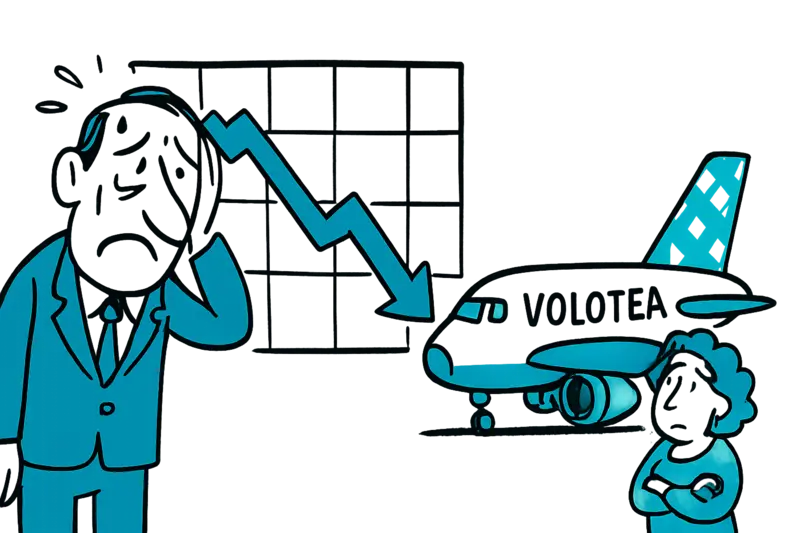
On the Brink: Volotea Fights for Survival — What Palma Can Expect Now
Volotea is negotiating its debts and plans to downsize its fleet. What consequences does this have for Palma, employees and the tourism season? A critical assessment and concrete proposals from a Mallorcan perspective.
On the Brink: Volotea Fights for Survival — What Palma Can Expect Now
Key question: How dependent is Palma on the fate of this airline — and who will absorb the effects if flights are canceled?
The news arrived dryly but with weight: Volotea has opened talks with its creditors, aims to restructure debt and is trying to avoid insolvency proceedings. At the same time, the company is working on a savings program that foresees shrinking the fleet from the current 44 to around 30–35 aircraft. For Mallorca this is not an abstract report — Volotea serves many French destinations and several domestic routes from Palma.
From the Plaça Major to the departures hall at Son Sant Joan: you can feel that something is in the air. On the way to the terminal I hear suitcases rolling, see taxi drivers nervously staring at their phone displays, and watch café owners at the small bar talk about whether arriving groups might be smaller. This everyday scene makes visible what numbers only suggest: small disruptions in the flight schedule immediately affect people and businesses here on site.
Critical analysis: An airline in trouble is not just a financial problem for the company. For Palma it is about network stability, work for ground staff, tourist bookings and pricing mechanics for connections. Volotea's assessment of the situation — high fuel costs, roughly €150 million in additional expenses — sounds plausible. At the same time, there are so far no clear indications of which routes will be cut or on what timeline reductions should be expected; similar uncertainty has followed other carriers' announcements, for example Ryanair Cuts Winter Flights — a Warning Signal for Mallorca.
The public discussion focuses on the number of aircraft and the seemingly secure continuation of flight operations. What is missing: an honest assessment of which weeks on the calendar and which target groups (business travelers, short-break tourists, connections to secondary French cities) would be most affected. Without this classification, hoteliers, travel agencies and local suppliers can hardly plan.
Another blind spot is the question of employees. Ground staff, crew members, catering companies and cleaning personnel often have fixed-term contracts or work through subcontractors. If capacities disappear, these people are hit first (Palma before the departure chaos: Ground staff strike plans put the island to the test). The lobby of the airport economy is strong, but the voices of employees have so far been barely heard in the communication.
What consequences could be conceivable? In the short term, there could be individual days with fewer seats or fully booked replacement flights. In the medium term, a permanent shift of certain connections to competitors is threatened — if those competitors are even interested (Ryanair threatens further cuts – How at risk is Mallorca?). In the long term there is a risk that Palma will lose attractiveness for direct connections to secondary cities, which would change visitor flows.
Concrete approaches that should be discussed locally: Short term there must be transparent information obligations: the airport authority and the airline should report bindingly which flights could be affected in the coming weeks (Ryanair vs. Aena: When an Airline Dispute Lands on Mallorca). Travelers need clear cancellation rules and points of contact.
Medium term a cooperation mechanism between the airport, the hotel industry and transport companies is advisable. For example, slot pools or temporary codeshare agreements with other airlines can help close gaps at short notice. A list of alternative carriers that can quickly increase capacity should be prepared.
State and regional authorities should examine whether a bridging fund for particularly vulnerable areas makes sense — not as a subsidy to the airline, but as a fund for employment programs and retraining of affected workers, coupled with strict transparency requirements.
Palma also needs a plan B for tourist demand: targeted promotion in core markets, flexible transfer solutions to alternative mainland airports and better coordination with ferry services where appropriate. The airport must not wait until gaps appear; planning must be proactive.
The public discourse also lacks the perspective of small providers: tour operators, taxi drivers, and holiday rental owners. These actors need rapid information channels and contact points. A local crisis circular from the airport or the chamber of commerce could help reduce uncertainty.
An everyday scene to take away: late one morning in front of the arrival gate two older women are sitting, one from Nantes, the other from Lyon. They talk about the past years, improved direct connections and which places on Mallorca they have visited for decades. For them connections are not abstract lines on a map, but access to friends, doctors and favorite cafés. If such connections become rarer, real lifelines are being cut.
Conclusion: Volotea's steps are a wake-up call for Palma. Act not in panic, but with vigilance — that is what is required now. Flight schedules may shift, companies may save, but the island needs jobs, reliable travel options and a coordinated response that is measured in hours, not days. Those who miss this risk that Mallorca will pay a price in the short term — not only financially, but in lost guests and unsettled people.
In short: more transparency, protection for employees, coordinated contingency plans and regional crisis management — these are the ingredients to prevent Palma from becoming a supporting character in an airline crisis.
Frequently asked questions
How dependent is Palma on Volotea, and what would happen if flights are canceled?
What short-term and medium-term effects could Palma face if Volotea reduces its fleet?
What concrete steps could help Palma prepare for airline disruptions?
How could authorities support Palma workers if Volotea cuts back?
What information should travelers expect during disruptions at Palma's airport?
How could Palma safeguard tourist demand if Volotea reduces service?
What role do small local providers play when a major airline faces trouble?
What’s the risk for Mallorca if direct connections to other cities decline?
Similar News

Persistent rain ahead: What Mallorca's everyday life needs to know now
Aemet announces several days of showers with a peak expected on Monday. A sober reality check: who is at risk, what is m...

New trick at Palma Airport: suitcase stolen from the belt — a reality check
On September 28 a 36-year-old allegedly stole a suitcase from the baggage belt of a 51-year-old German passenger at Palm...

Urgent Clearing of Palma's Torrents: Flood Prevention or Symptom of Short-Sighted Planning?
The city of Palma is responding to storm forecasts and has cleared several torrents. We ask: Is the short-term clearing ...

Evaneos and Mexico: A Reality Check for Sustainable Travel
Travel advertising often reads like a promise: local, sustainable, unique. But how deep do these promises really go? A c...

From Megapark to the Altar: Party Singer Now Offers Weddings in Mallorca
A well-known party artist combines partying and marriage: instead of a traditional church there are ceremonies at the Me...
More to explore
Discover more interesting content

Can Cap de Bou

Townhouse Lleo 72
