
Yellow Flag, Whistles, Silence: A Bathing Accident in Cala Domingos Petit
Yellow Flag, Whistles, Silence: A Bathing Accident in Cala Domingos Petit
A roughly 70-year-old German holidaymaker died after ignoring the yellow warning flag in Cala Domingos Petit. An analysis of why warnings often aren't enough.
Yellow Flag, Whistles, Silence: A Bathing Accident in Cala Domingos Petit
A man dies despite immediate resuscitation efforts — what went wrong, what is missing from the debate?
Late in the morning, around 11:45 a.m., a roughly 70-year-old German holidaymaker was pulled from the water at the small bathing cove Cala Domingos Petit near Cala Millor / Calas de Mallorca. The yellow warning flag was flying on site; lifeguards signaled to the man with whistles that he should not swim further out. Nevertheless he moved away from the shore, was shortly afterwards found motionless, floating on the water surface, and brought ashore.
Rescue personnel immediately began cardiopulmonary resuscitation. Several helpers from both sections of the beach and an emergency doctor fought for the man’s life for more than 40 minutes. In the end, the emergency teams pronounced him dead. National police and local police confirmed the identity of the deceased and spoke with a relative who had been on the beach at the time of the incident.
Central question: Why do people ignore warnings at the sea even when rescue staff intervene loudly, as in the red-flag incident in Talamanca?
The answer is not one-dimensional. A mixture of underestimation, habit, language diversity, and health factors play together. Older bathers often feel experienced; the memory of countless previous swims without incident creates a false sense of security. In addition, the yellow flag often appears to many as a mere recommendation — not as a concrete risk that requires immediate action. Similar fatal outcomes occurred elsewhere, for example the death of a 79-year-old professor in Cala Blava.
The situation at Cala Domingos Petit illustrates further problems: signage is not enough if it exists only visually; a whistle is quickly drowned out when children scream, motorboats run in the distance, and tourists lie on sunbeds. The rescuers’ tactics were exemplary, but medicine has its limits when circulatory failure occurs in open water; quick interventions can help, as in the near-drowning at Cala Vinyes.
What is often missing in public debate: reliable figures on location, time, and causes of bathing accidents, transparent evaluation of operation reports, and an honest discussion about age-related risks when swimming in the Mediterranean. Also rarely discussed: the role of weather, currents, and surf conditions, which are barely visible to outsiders but can provoke slow drifting away.
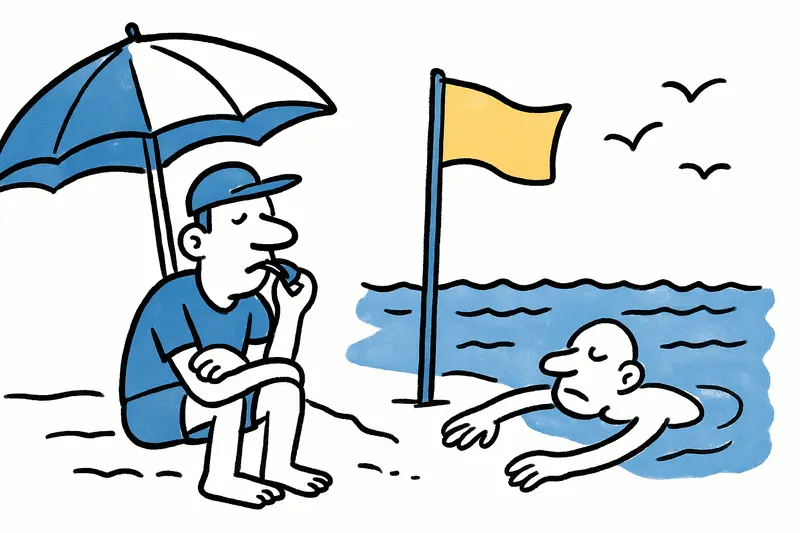
A scene from the beach: The heat presses down, the sand glows, a few seagulls circle, voices mix with the distant sound of the promenade. The yellow flag flutters on its pole, a young lifeguard sits partially in the shade of an umbrella and looks out to sea. He has the whistle ready, but he cannot stand next to every swimmer.
Concrete measures that could help here:
- Better information signs: Multilingual, easy-to-understand pictograms at access points to small coves that explain what the yellow flag concretely means (e.g., "Possible strong current – keep distance from the shore").
- Visible markings: Swim zones marked by buoys even in narrow, popular coves; this helps bathers more easily recognize where it is safer to stay.
- Loudspeaker announcements in several languages: Short and concise, especially on weekends and around midday when many families are at the beach.
- More public defibrillators and first-aid courses: At beach accesses and promenades, combined with information campaigns in accommodations and rental centers.
- Stronger prevention aimed at older bathers: Notices in tourist brochures and at car rental desks: seawater is not a still pool; pre-existing conditions and medications increase the risk.
- Local evaluation: Systematic recording of bathing accidents by location and cause so that measures can be implemented precisely, as cases like the Can Picafort death of a 62-year-old tourist show.
One final, clear thought: Lifeguards are there to save lives — not to permanently prevent reckless behavior. Those who ignore the warning flag risk not only their own life but also the burden of heavy operations for helpers and the strain on relatives who often remain on the beach. Respecting flags and the instructions of rescuers is not bureaucratic know-it-all behavior but a practical life insurance.
The cove on the east coast has returned to calm, the whistle lies in the lifeguard’s bag, the flag remains yellow. The question remains: will we learn enough from this so that such a morning does not end in mourning again?
Frequently asked questions
What does a yellow flag mean at Mallorca beaches like Cala Domingos Petit?
Why do people ignore lifeguard warnings at Mallorca’s beaches, even when whistles are heard?
What concrete safety steps could improve safety at Cala Domingos Petit?
How common are multilingual safety signs at Mallorca beaches and why are they important?
What should a visitor do during a yellow flag day on a Mallorca beach?
Are there specific risks for older swimmers on the Mallorca coast?
How can Mallorca improve data collection on bathing accidents to prevent recurrences?
What role do weather and currents play in swimming safety around Mallorca?
Similar News

Mallorca gets winter link to Lyon: Transavia France flies from October
Transavia France will launch a winter direct connection Palma–Lyon from late October: twice weekly, around 17,000 seats ...
Ses Fontanelles: 1,700 Years Underwater – the Wreck That Makes Mallorca Proud
A Roman merchant ship lay hidden for 1,700 years off Can Pastilla. Now Ses Fontanelles is in the spotlight: salvage, con...
Mini-tsunamis in Mallorca: Harmless natural phenomenon — or an underestimated danger?
Two harbor towns in Mallorca recorded unusual water level fluctuations. An analysis: How rissagas form, who is at risk —...
Stinging jellyfish in Cala Banyalbufar: Why everyone suddenly fled the water
In Cala Banyalbufar, Pelagia noctiluca washed up in droves. A personal account of why this is no coincidence, what is of...
New low-pressure trough brings rain — and the heat remains: What's missing in Mallorca?
A short, intense window of showers hit Mallorca, yet the air remained muggy and warm. Key question: Why does rain hardly...
More to explore
Discover more interesting content

Boat Tour with BBQ along Es Trenc Beach

Private transfer from Mallorca Airport (PMI) to Pollensa
