
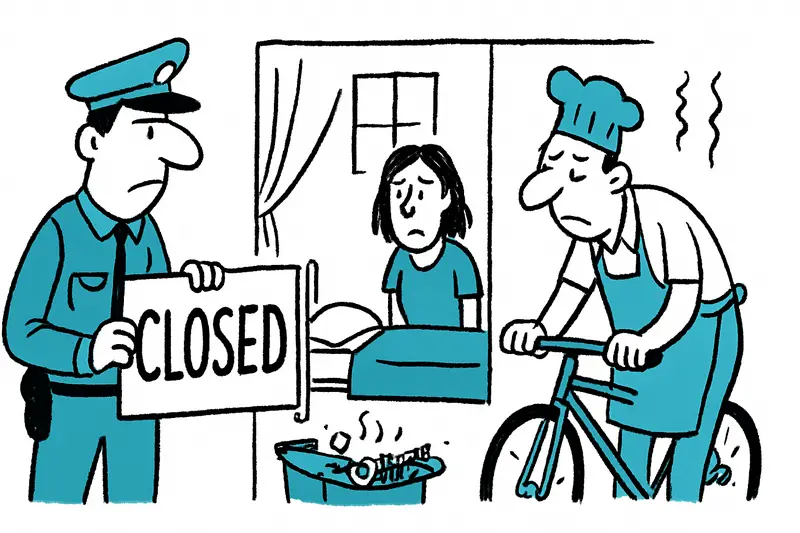
Cala Millor: Restaurant closed – Workers lived in makeshift rooms, hygiene failures and long shifts uncovered
Cala Millor: Restaurant closed – Workers lived in makeshift rooms, hygiene failures and long shifts uncovered
Inspections in Cala Millor revealed cramped sleeping rooms next to the kitchen, violations of hygiene rules and exploitative working hours. What does this say about inspection, sanctioning practices and the local tourism economy?
Cala Millor: Restaurant closed – Workers lived in makeshift rooms, hygiene failures and long shifts uncovered
A mild morning on the promenade, but behind the scenes it smells of more than fish: authorities order provisional closure
In the early morning, as the promenade in Cala Millor slowly awakens and the first beach-lounger vendors set up their stalls, a police car pulled up in front of a restaurant in the town center a few days ago. The local police of Sant Llorenç and the Spanish National Police conducted joint inspections, supported by health, labor and housing inspectors. The result: the establishment was provisionally closed, mirroring recent enforcement stories such as Plaça Major: Shadows Behind the Menu — Arrests After Alleged Exploitation.
The facts recorded by the authorities are clear: inspectors found a total of 15 employees at the business. Three of them did not have a valid residence permit; twelve others were formally registered only as part-time workers but in reality worked far more hours – according to labor inspection investigations, actual shifts lasted up to 13 hours a day, seven days a week. At the same time, food inspectors discovered serious deficiencies in storage and handling: cold chains were not maintained, products were not stored separately and preparation surfaces did not meet minimum requirements.
What alarmed the housing authorities in particular: several employees slept directly in the restaurant in a total of nine makeshift rooms. According to the inspectors, these were poorly ventilated, had no separate sanitary facilities, were heavily soiled and were located directly next to the kitchen and storage areas. The smell of food and the lack of separation between work and living areas made the accommodations unsuitable in the inspectors' view. Similar findings have surfaced in nearby municipalities, for example Living on the Edge of the Law: Eleven Illegal Shelters in Manacor as a Wake-up Call.
The health authority reacted by immediately closing the business; the operator was given a ten-day deadline to remedy the deficiencies. At the same time, the labor inspectorate initiated sanctioning procedures. Expulsion proceedings were started against the three without valid residence permits; additionally, the police are examining whether criminal offences regarding violations of worker rights have occurred.
Key question: why do such cases repeatedly arise particularly in strongly tourism-driven places like Cala Millor, and why do existing inspections apparently not suffice to prevent such abuses in the long term?
Critical analysis: at first glance the inspections appear decisive. On closer inspection, however, gaps become apparent. Temporary closures and fines often affect only the operator of the specific establishment, but do not remove the structural causes: high cost pressure in the high season, recruitment of cheap labor through shadow networks, and a situation in which employers can provide accommodation as part of the pay without this being standardized and controlled. The high cost pressure is a broader trend covered in Empty Tables, Growing Worries: Why Mallorca's Gastronomy Is on Low Flame. Inspections are usually reactive – following tips or chance discoveries – and less preventive. That reduces their deterrent effect.
What is missing in the public debate: there is little discussion about the role of supply chains, landlords and intermediaries. Often multiple parties are involved in the employment chain: caterers, recruitment agencies, subcontractors. If employers provide accommodation, its condition should be part of the regular licensing requirements. The persistence of unregulated short-term rentals and related listings has also complicated oversight, as discussed in Illegal Holiday Listings in Mallorca: Why Enforcement Fails and How It Could Work Better. Furthermore, it remains unclear how COVID and health protection plans are being implemented and monitored during the ongoing summer season.
Everyday scene from Cala Millor: around 4 a.m. dishwashers and cooks leave the restaurant; some show visible fatigue; they wait for buses or push bicycles along the slightly damp promenade. In summer, haste prevails; behind the busy street cafés, however, many problems accumulate: cramped housing, noise and the expectation to serve guests during the day – an exhaustion visible on the quiet buses that take workers home after sunrise.
Concrete solutions that could help locally: first, a mandatory registration requirement for employer-provided accommodation with regular unannounced inspections. Second, graduated, substantial sanctions that, in addition to the business, also affect property owners, recruitment agencies and, where appropriate, suppliers. Third, an anonymous reporting system for employees and guests that enables rapid responses, and a low-threshold advisory center on the island for exploited workers—ideally in cooperation with consulates.
Further measures: electronically record working hours, provide sector-specific training for businesses on hygiene standards and accommodation obligations, and maintain a publicly accessible register of violations so that guests and business partners can make informed decisions. Finally, towns like Sant Llorenç and Manacor should finance additional inspection teams during the high season, because staffing needs rise with visitor numbers.
Conclusion: the closure in Cala Millor is a necessary step, but not a cure. Inspections repeatedly catch individual cases; the problem runs deeper: a system that rewards cheap labor and blurs responsibility for dignified housing. When enjoying a plate of paella on the beach, one should be aware: cheap service can come at a high price for people. If administration, courts, employers and guests keep their eyes open together, pressure on employees can be reduced. Otherwise the promenade may remain clean, but the darker sides will simply move elsewhere.
Frequently asked questions
Why was a Cala Millor restaurant closed provisionally?
What did inspectors find about workers' living conditions in Cala Millor?
What were the labour law concerns raised in Cala Millor?
What actions did authorities take after the closure?
Why do problems like this keep arising in tourism-heavy places like Cala Millor?
What solutions were proposed to prevent such abuses in Mallorca?
What are the potential consequences for workers and employers after such a closure?
What can visitors to Mallorca do to understand restaurant standards and support good practices?
Similar News

Palma, Palma de Mallorca, Palma‑Mallorca: What is it really about?
The debate over the city's name is more than grammar: it concerns identity, law and branding policy. A sober reality che...

Warning to Bathers: Nipping Fish in Cala Major and Other Coves — a Reality Check
In Cala Major and several beaches around Mallorca, bathers report painful “nips”. Who are the animals, why are they gett...

Rental Car Theft in El Arenal: What This Incident Reveals About Our Gaps
A teenager steals a running rental car in El Arenal, flees on foot, climbs over walls and is caught by the Guardia Civil...

Red Rope in Palma's Library: What Helps Against Selfie Tourism — and What's Missing
Palma's city library cordoned off an area with a red rope to keep selfie tourism away from reading and working activitie...

Fort San Carlos: Museum, Harbor Dispute — and a Conflict That Demands Answers
The military museum at Fort San Carlos sits right on Palma's harbor, with unexpectedly quiet rooms filled with cannons a...
More to explore
Discover more interesting content

Can Cap de Bou

Townhouse Lleo 72
